

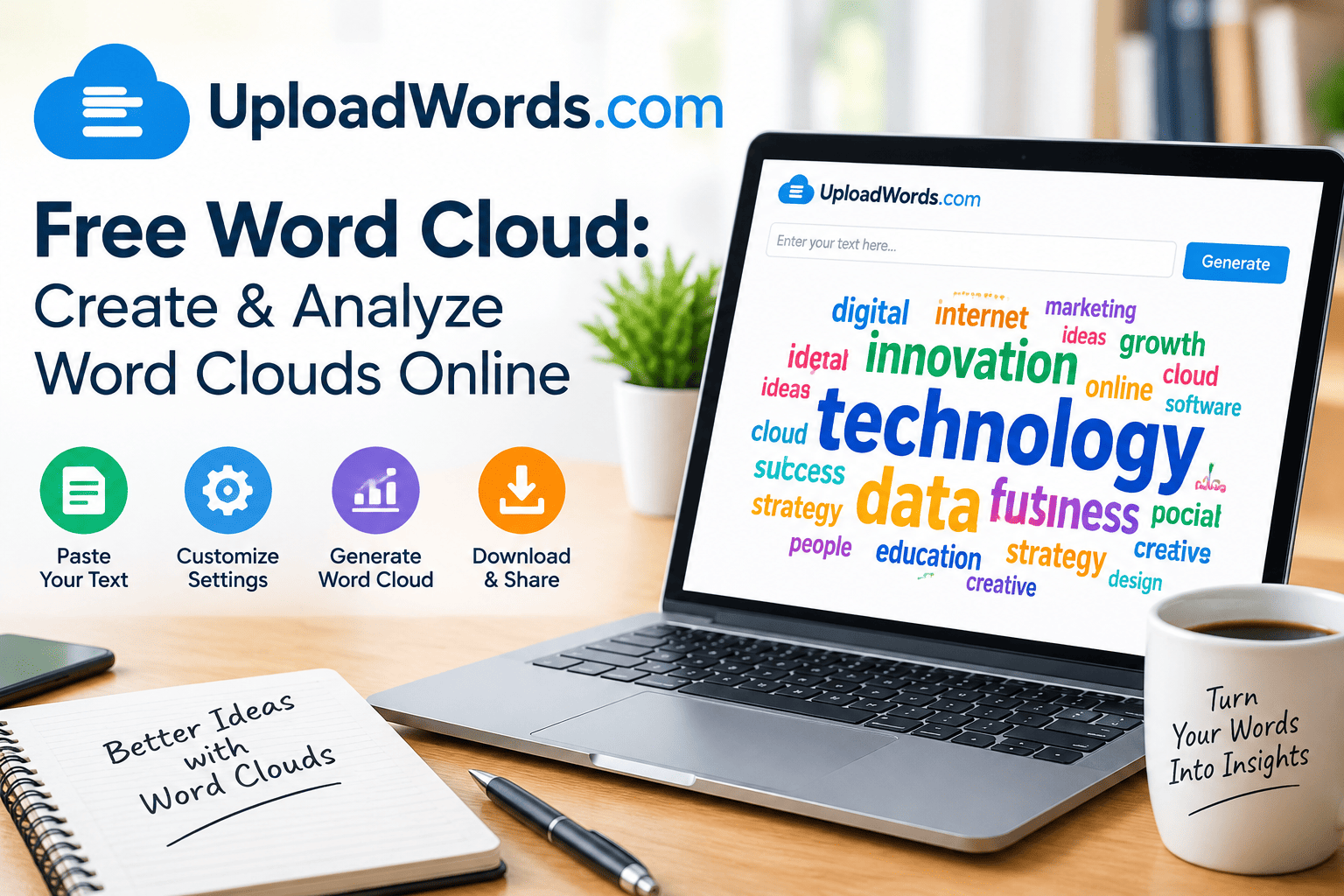
Working with large amounts of text can sometimes be difficult, especially when you want to understand the main ideas quickly. A long article, research document, survey, or collection of responses may contain hundreds or even thousands of words, making it challenging to identify the terms that appear most often. This is where a word cloud can be useful. By turning text into a visual format, a word cloud makes frequently used words easier to recognize and gives users a quick overview of the language within their content.
For people searching for uploadwords.com free word cloud, the main attraction is the possibility of using an online tool to transform ordinary text into a visual word-based representation. Word clouds can be useful for students, teachers, bloggers, marketers, researchers, businesses, and anyone who wants to explore text in a more visual way. Instead of manually scanning a document for repeated words, users can use a word-cloud approach to discover patterns and recurring terms more efficiently.
What Is UploadWords.com Free Word Cloud?
UploadWords.com free word cloud is a search phrase associated with people looking for an online solution to create word clouds from text. The basic concept behind a word-cloud tool is straightforward: users provide text, the system processes the words, and the resulting visualization displays terms according to their frequency or prominence. Words that occur more often may appear larger, while less frequent words may appear smaller.
This type of visualization can make large blocks of text easier to explore. For example, if you create a word cloud from an article about digital marketing, words related to marketing, content, search, websites, and SEO may become visually prominent. This does not replace detailed reading or professional analysis, but it can provide a useful first impression of the subjects discussed in the original text.
What Is a Word Cloud and How Does It Work?
A word cloud is a visual representation of words extracted from a particular text source. Its primary purpose is to show which words occur frequently, allowing readers to identify recurring vocabulary without having to examine every sentence individually. The size, position, or visual prominence of a word can be used to represent its frequency within the source material.
The process behind a basic word cloud involves analyzing the supplied text and counting or evaluating the occurrence of different terms. Depending on the tool, common words may be filtered out, while other settings may allow users to customize the number of words included in the final visualization. The result is a graphic that can provide an immediate overview of the vocabulary associated with a document or topic.
It is important to understand that a word cloud shows frequency rather than complete meaning. A word appearing in a large font does not necessarily mean that it is the most important concept in the document. Context, sentence meaning, and relationships between different terms still require human interpretation.
How to Create a Word Cloud With UploadWords.com
Creating a word cloud online is generally a simple process, although the exact interface and available features can vary depending on the platform. The first step is to prepare the text you want to analyze. This could be an article, essay, survey responses, research notes, interview material, or another collection of written content. Using relevant and clean text is important because unnecessary material can affect the final visualization.
Once your content is ready, provide it to the word-cloud tool using the input method supported by the website. After the text has been processed, the tool can generate a visual representation based on the words it identifies. Depending on the available functionality, you may also be able to modify aspects of the result to make it easier to read or more suitable for a particular project.
After generating the word cloud, review the result carefully instead of immediately assuming that the largest words represent the most important ideas. Look for recurring terms that actually relate to the subject of your content. If customization or filtering options are available, use them to improve the clarity of the visualization. Once the result meets your needs, you can use it for a presentation, project, research activity, or other appropriate purpose if the platform provides suitable saving or export functionality.
Why Use a Free Word Cloud Tool?
One of the biggest advantages of a free word-cloud tool is convenience. Traditional text analysis can require considerable time, particularly when working with a large document. A word cloud provides a visual shortcut that can help users notice recurring words and general themes much faster.
Another advantage is accessibility. You do not necessarily need advanced technical knowledge to understand a basic word cloud. The visual format is easy to interpret, which makes these tools useful in classrooms, presentations, brainstorming sessions, and content research.
Word clouds can also make otherwise boring or text-heavy information more engaging. A large collection of survey responses, for example, may be difficult to present in its original form. A word cloud can turn that information into a visual summary that gives viewers an immediate sense of the language people are using.
Key Features to Look for in a Free Word Cloud Generator
When choosing an online word-cloud tool, simplicity should be one of the first considerations. A good tool should make it relatively easy to add text and generate a useful visualization without requiring complicated technical steps. Users should also look for tools that provide enough customization to make the final result readable and appropriate for their purpose.
Text-handling capabilities are another important factor. Depending on the project, users may want to remove common words, control how many terms appear, or make other adjustments to improve the usefulness of the visualization. Export and sharing options can also be valuable when the word cloud is being used in presentations, reports, or educational projects.
Privacy should not be overlooked either. If your text contains confidential business information, private customer feedback, personal information, or unpublished research, review the service’s current privacy and data-handling policies before uploading it. Free access does not automatically mean that every type of information is appropriate to submit.
Who Can Use UploadWords.com Free Word Cloud?
A word cloud can be useful for many different audiences because it does not require specialized knowledge to understand the basic visualization. Students can use word clouds to explore essays, reading assignments, research notes, and project material, while teachers can use them as classroom activities. For example, students can submit words related to a lesson topic and then discuss the terms that appear most frequently.
Bloggers and writers can also benefit from word clouds during the research and brainstorming process. When working with a large collection of notes or source material, a visualization can reveal recurring terminology that might otherwise be overlooked. It can help a writer understand the language surrounding a subject before organizing a more detailed article.
Marketers and businesses can use word clouds to examine customer feedback, survey responses, product comments, and other forms of written communication. If certain subjects appear repeatedly, they may deserve closer attention. Researchers can similarly use word clouds as an initial visualization before performing more detailed qualitative or quantitative analysis.
Practical Ways to Use a Word Cloud
One of the most practical uses of a word cloud is content research. If you are studying a particular subject and have collected several relevant documents, creating a visualization can help you identify commonly occurring terminology. This can provide a useful starting point for further research and help you understand how a topic is commonly discussed.
Word clouds are also useful for analyzing feedback. Businesses that receive a large number of written comments may find it difficult to identify broad patterns simply by reading responses one at a time. A word cloud can provide an initial overview of the vocabulary customers are using, although individual responses should still be reviewed before making important decisions.
In education, word clouds can make lessons more interactive. A teacher might ask students to provide words describing a book, historical event, scientific concept, or classroom topic. The resulting visualization can then become a starting point for discussion. Presenters can also use word clouds to make text-heavy information more visually interesting.
Benefits of Using a Free Word Cloud Generator
The main benefit of a word cloud is that it provides a quick visual summary of text. Instead of reading a large document solely to identify repeated terminology, users can generate a visualization and immediately see which words stand out. This can save time during the early stages of research and organization.
Another advantage is visual communication. A word cloud can make written information more accessible to an audience that may not want to read a large block of text. This is particularly useful in presentations, classrooms, reports, and brainstorming sessions where visual elements can help maintain attention.
Word clouds are also flexible. The same basic concept can be applied to articles, survey responses, notes, reviews, speeches, interviews, and many other types of text. Their usefulness depends largely on the quality of the source material and how thoughtfully the results are interpreted.
Limitations of Word Clouds You Should Know
Although word clouds are useful, they should not be treated as a complete text-analysis solution. Their biggest limitation is that they generally focus on word frequency rather than context. Seeing a word appear frequently does not explain why it was used, what the writer intended, or how it relates to other ideas in the text.
For example, imagine a customer-feedback document in which the word “problem” appears frequently. A word cloud may make that term highly visible, but it cannot tell you whether customers are talking about pricing, delivery, product quality, technical support, or something else. To understand that information, you still need to examine the original responses.
Common words can also influence the final result. If irrelevant or frequently used words are not filtered appropriately, they may dominate the visualization and make important terms less noticeable. For this reason, word clouds are generally most useful as an exploratory tool rather than as the final method of analysis.
UploadWords.com Free Word Cloud vs. Manual Word Analysis
Both automated visualization and manual analysis have advantages. A free word-cloud tool can process text quickly and provide an immediate visual overview, while manual analysis gives a person the ability to understand context, tone, relationships, and meaning in much greater detail.
| Factor | Free Word Cloud | Manual Analysis |
| Speed | Fast | Slower |
| Visual Overview | Excellent | Limited |
| Large Text Collections | Convenient | Time-consuming |
| Context | Limited | Strong |
| Detailed Interpretation | Limited | Strong |
| Best Use | Initial exploration | In-depth analysis |
The most effective approach can be to combine both methods. A word cloud can help identify patterns and recurring vocabulary, while manual review can explain what those patterns actually mean.
How Word Clouds Can Support SEO Content Research
Word clouds can also have a supporting role in SEO content research. When researching a subject, writers may collect relevant articles, notes, survey responses, or other text and use visualization to identify recurring terminology. This can help them understand the vocabulary associated with a topic before creating their own content.
However, a word cloud should never be used as a substitute for genuine keyword research or search-intent analysis. Simply repeating words because they appear frequently in other content does not automatically improve an article. Modern content should be written for people first, with keywords included naturally where they make sense.
A stronger SEO workflow combines topic research, search intent, original information, accurate facts, useful examples, and clear organization. A word cloud can support that process by helping writers explore language patterns, but it should remain one tool within a broader research strategy.
Best Practices for Creating Useful Word Clouds
The quality of a word cloud depends heavily on the quality of the source material. Start with text that is directly related to the subject you want to explore and remove unnecessary material where appropriate. If the source contains duplicated content or unrelated sections, the resulting visualization may give a misleading impression of the topic.
It is also important to interpret the results carefully. A frequently appearing word may be important, but it could also simply be a common term used throughout the document. Look beyond the largest words and consider the context in which they appear.
Finally, use word clouds as a starting point rather than a final conclusion. They are excellent for discovering patterns and generating ideas, but detailed research still requires reading, interpretation, and sometimes additional analytical methods.
How AI Can Be Used Responsibly in Word Cloud Content
Artificial intelligence can be useful when researching a topic, organizing information, generating an initial outline, or improving the structure of an article. However, AI-generated content should not simply be published at scale without meaningful review or additional value. The goal should always be to create content that genuinely helps the reader.
Accuracy is especially important when writing about online tools. Features, interfaces, pricing, privacy policies, and available functions can change over time. AI systems can also produce incorrect information, so important claims should be checked against reliable and current sources before publication.
A responsible approach is to use AI as an assistance tool rather than a replacement for editorial judgment. Research the topic, verify important details, add useful explanations and original insights, and carefully review the final article before publishing it. This produces content that is more trustworthy and useful than pages created simply to target search terms.
Is UploadWords.com Free Word Cloud Worth Using?
For users who want a simple visual overview of written content, a free word-cloud solution can be useful. It can help students understand text, teachers create visual activities, marketers explore customer language, writers organize ideas, and researchers identify recurring terms.
Its usefulness ultimately depends on the task. A word cloud is excellent for quick visualization and initial exploration, but it should not be expected to provide the same depth as specialized text-analysis software or detailed human research. Users should also check the current features, privacy information, and terms of the specific service before using it for important or sensitive projects.
Frequently Asked Questions
Is UploadWords.com Free to Use?
The availability of specific free features can change over time, so users should check the current UploadWords.com website for the latest information about its word-cloud functionality and any applicable limitations.
What Is a Word Cloud Used For?
A word cloud is used to visualize words from a text source and highlight terms that appear frequently or prominently. It can be useful for education, brainstorming, research, presentations, surveys, and content analysis.
Can I Create a Word Cloud From an Article?
Yes, an article can serve as the source text for a word cloud. The resulting visualization can help you see recurring vocabulary and get a quick overview of the article’s main terminology.
Are Word Clouds Useful for SEO?
Word clouds can support SEO research by helping writers explore recurring terminology around a subject. However, they are not a replacement for keyword research, search-intent analysis, competitor research, or high-quality content creation.
Can a Word Cloud Replace Keyword Research?
No. A word cloud primarily visualizes words within a particular text, while keyword research considers factors such as search behavior, relevance, competition, intent, and audience needs. These are different processes.
Final Thoughts
UploadWords.com Free Word Cloud can be a useful concept for anyone looking for a simple way to turn written content into an easy-to-understand visual representation. From students and teachers to marketers, researchers, writers, and businesses, different types of users can benefit from seeing recurring words presented visually rather than buried inside a long document.
The most important thing is to understand the purpose and limitations of the technology. A word cloud can quickly reveal frequently used terms and provide useful starting points for research, but it cannot fully explain context or meaning. Combining visual analysis with careful human interpretation will generally produce better results.
For content creators, the same principle applies. An article about a word-cloud tool should not exist simply to target a keyword. It should answer real questions, provide accurate information, explain practical uses, acknowledge limitations, and give readers something genuinely useful. When content focuses on relevance, accuracy, originality, and user value, it becomes much more valuable than a page created only for search-engine visibility.
 Ethan Carter