
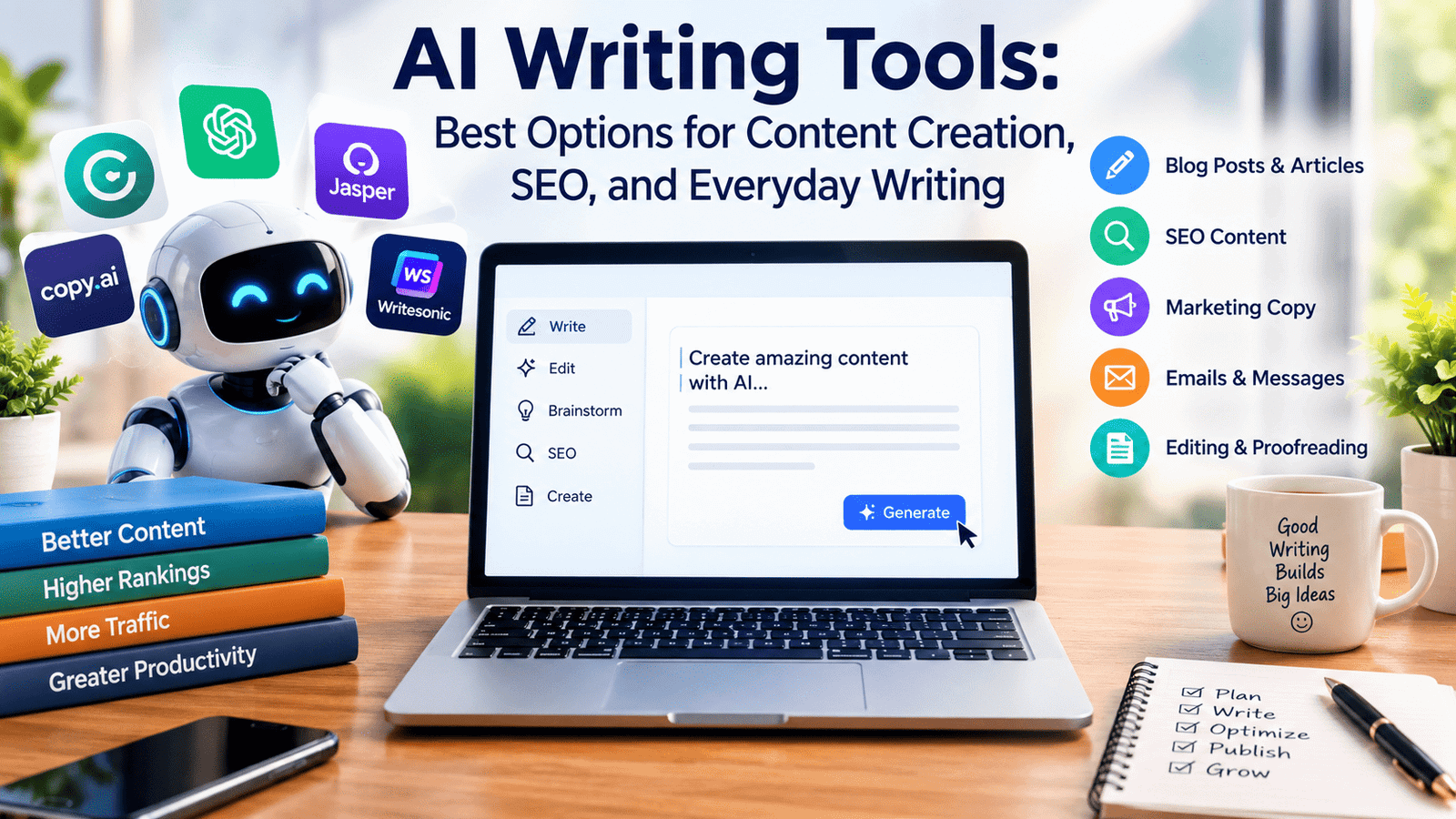
AI writing tools are software applications that use artificial intelligence to help people create, edit, improve, and organize written content. They can assist with blog posts, website copy, product descriptions, emails, social media captions, outlines, and other writing tasks. Popular options include ChatGPT, Grammarly, Jasper, Copy.ai, and Writesonic, although their features and intended audiences differ. The right choice depends on your writing goals, budget, preferred workflow, and the amount of human editing required. These tools can save time, but factual accuracy, originality, tone, and usefulness still require careful review.
What Are AI Writing Tools?
AI writing tools are digital assistants designed to make writing more efficient. They use language models and other AI technologies to generate text, rewrite sentences, summarize information, suggest ideas, and improve grammar. Instead of beginning every task with a blank page, users can provide instructions and receive a draft that they can review and refine.
These tools support different stages of the writing process. A blogger might use AI to develop article ideas and create an outline, while a marketing professional might use it to brainstorm advertising headlines or draft a product description. Students can use suitable tools to understand difficult concepts, organize notes, and improve their writing skills in accordance with their school’s rules.
However, an AI-generated draft is not automatically accurate or ready to publish. The quality of the result depends on the tool, the instructions provided, the available context, and the user’s ability to evaluate the output.
Best AI Writing Tools to Consider
Different writing platforms serve different purposes. Some are general-purpose assistants, while others focus on grammar correction, marketing campaigns, or content production.
1. ChatGPT
ChatGPT is a general-purpose AI assistant that can help with a wide range of writing tasks. Users can request blog outlines, article drafts, headline ideas, explanations, summaries, email drafts, and revisions to existing text.
One of its main advantages is flexibility. You can specify the audience, tone, format, length, and purpose of a piece of content. For example, a website owner can ask for an informative article introduction, then request a clearer explanation or a more engaging headline.
ChatGPT can also assist with content planning and keyword organization. However, it may produce incorrect details or unsupported claims, so important information should be checked against reliable sources before publication.
Best for: General writing, brainstorming, outlining, drafting, and revising content.
2. Grammarly
Grammarly focuses on writing assistance, including grammar, spelling, punctuation, clarity, and tone. Its AI features can also help users rewrite sentences and generate or refine text, depending on the available plan and product features.
It is particularly useful when a draft already exists but needs improvement. A writer can use it to identify awkward wording, reduce unnecessary repetition, and make an email or article easier to understand.
Grammar correction alone does not guarantee strong writing. A grammatically correct paragraph may still contain weak arguments, inaccurate facts, or repetitive ideas. Writers should review suggestions to ensure that the original meaning and intended voice remain intact.
Best for: Proofreading, clarity, grammar, and polishing existing drafts.
3. Jasper
Jasper is an AI platform designed primarily for marketing and business content. Its capabilities are aimed at helping teams create campaign materials, maintain a consistent brand voice, and organize content production.
Marketing teams may use it to develop advertising copy, promotional emails, landing-page content, and campaign variations. Its value is especially relevant when several people need to produce material that follows the same brand guidelines.
Jasper may be more than an individual writer needs for occasional articles. Before choosing a paid plan, users should examine its current features, usage limits, and pricing to determine whether a dedicated marketing platform is worthwhile.
Best for: Marketing teams, campaign content, and brand-focused writing workflows.
4. Copy.ai
Copy.ai is associated with AI-assisted marketing and go-to-market workflows. Depending on the available features, it can support the creation of sales messaging, marketing copy, campaign ideas, and repeatable business content processes.
For example, a business could use an AI-assisted workflow to prepare different versions of a product message for different audiences. The resulting text still needs to be checked for accuracy, appropriate claims, and consistency with the company’s actual products and services.
Users should distinguish between a tool for generating individual pieces of copy and a platform designed to coordinate broader marketing or sales processes.
Best for: Marketing copy, sales messaging, and structured business workflows.
5. Writesonic
Writesonic provides AI-powered content and marketing capabilities, with features and positioning that may change over time. It can be relevant to users working on website content, search-focused articles, and digital marketing tasks.
For SEO professionals, the important consideration is whether a platform’s current capabilities match the complete content workflow. Generating text is only one part of publishing a useful article. Research, search intent, original insights, factual checking, internal linking, and editorial review also matter.
Before subscribing, compare the specific tools included in the current plan rather than assuming every plan offers the same research or optimization features.
Best for: Users exploring AI-assisted web content and search-focused marketing workflows.
Comparison of Popular AI Writing Tools
The following table summarizes the general strengths of these platforms rather than presenting an independently tested ranking.
| Tool | Main purpose | Suitable use cases |
| ChatGPT | General-purpose AI assistance | Articles, outlines, ideas, rewriting |
| Grammarly | Writing improvement | Grammar, clarity, proofreading |
| Jasper | Marketing content | Campaigns, brand messaging |
| Copy.ai | Marketing and sales workflows | Promotional copy, sales messaging |
| Writesonic | AI-assisted content and marketing | Website content, SEO-related workflows |
Features, integrations, usage limits, and subscription prices can change. Check each provider’s current offering before making a purchasing decision. A more expensive platform is not necessarily better for every writer.
Key Features to Look for in AI Writing Tools
Choosing a suitable tool requires more than checking whether it can generate text. The most useful features depend on the type of content you create and how much control you need over the final result.
Content Generation
Content generation allows users to produce an initial draft from a topic, prompt, brief, or set of instructions. It is useful for brainstorming, building outlines, drafting introductions, and exploring different ways to explain a subject.
For long-form content, look for tools that can follow detailed instructions and maintain consistency across sections. Even then, the generated article should be reviewed for repetition, missing context, and unsupported statements.
Grammar and Style Improvement
Writing assistants can identify spelling errors, improve sentence structure, and suggest clearer wording. Some can adjust the tone to suit a professional email, informative blog post, or marketing message.
The best editing process does not automatically accept every suggestion. Unnecessary changes can remove a writer’s personality or alter the intended meaning.
SEO Content Support
Some AI writing tools include features for organizing keywords, preparing article outlines, reviewing headings, or supporting search-focused content workflows.
These features can help with planning, but they cannot guarantee higher rankings. Effective SEO requires an understanding of search intent, useful information, technical accessibility, credible sourcing, and a positive reader experience.
Summarization and Research Assistance
AI assistants can summarize supplied material, extract key themes, and suggest questions for further investigation. This can be helpful when preparing a research outline or reviewing a long document.
A summary should not replace reading important source material when precise wording, context, or evidence matters. When an AI tool provides references, open and verify the original sources rather than assuming that every citation is correct.
Tone and Audience Adaptation
Different audiences need different explanations. A technical guide may require precise terminology, while a beginner’s article benefits from straightforward language and examples.
Useful AI writing tools allow users to specify the intended audience, reading level, tone, and format. These instructions make the output more relevant, although the final wording still needs editorial judgment.
Benefits of Using AI Writing Tools
AI-assisted writing can improve productivity when the tools are used for appropriate tasks.
Faster first drafts: Writers can move from an idea to a preliminary outline or draft without developing every sentence from scratch.
More ideas to explore: AI can suggest alternative titles, article angles, questions, and examples when a writer is unsure how to approach a topic.
Improved readability: Editing features can help identify confusing sentences, spelling mistakes, and unnecessary wording.
Support for repetitive tasks: Businesses can use AI to prepare draft descriptions, standard email responses, and variations of routine messages.
Flexible writing assistance: A single general-purpose assistant may help with several types of writing, reducing the need to learn multiple separate applications.
The actual benefits depend on the task and the amount of editing needed. AI output that requires extensive correction may save less time than expected.
Limitations of AI Writing Tools
Despite their advantages, AI writing tools have important limitations that users should understand before relying on them.
Incorrect or Outdated Information
AI systems can generate statements that sound convincing but are false, incomplete, or outdated. This is especially important for articles covering current events, public figures, statistics, medical subjects, legal issues, and product specifications.
Writers should verify significant claims against trustworthy, relevant sources and update information when circumstances change.
Repetitive and Generic Content
AI-generated drafts can repeat familiar expressions, use predictable headings, or explain obvious points without providing meaningful detail. Publishing such content without substantial review can make a website less useful to readers.
Improve the draft by adding specific examples, original analysis, firsthand observations where available, and information that directly answers the reader’s question.
Limited Original Experience
An AI assistant cannot independently provide genuine firsthand experience simply by writing in a personal tone. It should not invent interviews, experiments, product tests, professional credentials, or personal stories.
Where experience matters, use authentic information from people who actually performed the activity or tested the product.
Privacy and Confidentiality
Some AI platforms may process submitted information under their own data-handling policies. Avoid entering passwords, private customer information, confidential business documents, or sensitive personal details unless the tool is approved for that purpose and its privacy arrangements are appropriate.
Subscription Costs and Usage Limits
Free plans can be useful for occasional tasks, but they may restrict usage, advanced features, or access to particular models. Paid plans may offer additional capabilities but are not automatically necessary.
Compare current prices, cancellation terms, data policies, and feature limits before committing to a subscription.
How to Choose the Right AI Writing Tool
Start by identifying the problem you want to solve. Someone who mainly corrects grammar needs different features from a marketing team producing campaigns or a blogger preparing detailed articles.
Consider these five factors:
- Your main writing task: Decide whether you need drafting, editing, research support, marketing workflows, or a combination of these.
- Ease of use: Choose a platform that fits your existing writing process and does not introduce unnecessary complexity.
- Output quality: Test the tool with a realistic assignment and evaluate the clarity, accuracy, structure, and amount of editing required.
- Budget: Compare free access and paid plans based on the features you will genuinely use.
- Privacy and control: Review the provider’s data policies and ensure that you can check, revise, and approve the final output.
A practical approach is to test a small number of tools using the same writing task. For example, ask each tool to prepare an outline for the same article, then compare the results against your requirements. This gives you a more useful basis for choosing than relying only on promotional claims.
How to Use AI Writing Tools for SEO Content
AI writing tools can support SEO work when they are part of a broader editorial process rather than a substitute for research and expertise.
Step 1: Understand Search Intent
Determine what readers actually want to know. A search for a definition requires a different article from a search comparing products or looking for instructions.
Review relevant search results and identify the questions your article needs to answer.
Step 2: Prepare a Detailed Content Brief
Give the AI tool the primary keyword, intended audience, article purpose, relevant subtopics, preferred tone, and factual requirements. Explain which claims need reliable sources and which details must not be invented.
A clear brief generally produces a more useful starting point than a vague instruction such as “write a ranking article.”
Step 3: Build a Logical Outline
Arrange the headings in an order that helps readers understand the subject. Cover the essential questions first, then introduce comparisons, examples, benefits, and limitations where relevant.
Avoid adding sections merely to increase article length.
Step 4: Research and Verify Information
Check facts, statistics, product details, dates, and quotations against reliable original sources. Remove unsupported claims and correct any misleading explanations.
AI-generated references should be treated as leads for verification, not automatic proof.
Step 5: Edit for Original Value
Improve the article with meaningful analysis, specific examples, useful comparisons, and clear explanations. Remove repetition and ensure that each section contributes something valuable.
Step 6: Review Before Publishing
Check the headline, introduction, headings, grammar, links, factual accuracy, and overall usefulness. Confirm that the content satisfies the reader’s needs and follows the website’s editorial standards.
Google’s published guidance explains that generative AI can assist with research and structure, but generating many pages without adding value may violate its scaled content abuse policy. The key issue is the usefulness and quality of the published content, not simply whether AI was involved.
Are AI Writing Tools Good for Beginners?
Yes. AI writing tools can help beginners understand article structure, develop ideas, correct grammar, and learn how to communicate more clearly.
A new writer can ask for an explanation of a topic, request an outline, and then develop the draft using their own understanding and research. Comparing alternative introductions or headlines can also help demonstrate how different writing choices affect clarity and tone.
However, beginners should avoid accepting every generated answer without understanding it. Learning to evaluate evidence, recognize weak arguments, and write independently remains important. For school assignments, follow the relevant academic rules and disclose AI assistance when required.
Do AI Writing Tools Help Content Rank on Google?
AI writing tools can support the production of search-focused content, but using them does not guarantee better rankings, faster indexing, or placement in featured snippets.
Search performance depends on many factors, including relevance, content quality, competition, site accessibility, reputation, and how well a page meets the user’s needs. A carefully researched article written with AI assistance may be useful, while a large collection of repetitive, low-value AI pages may perform poorly and create policy risks.
For stronger results, use AI to support research planning, outlining, and editing. Add original information, verify claims, answer the search query directly, and evaluate performance using appropriate SEO analytics.
Common Mistakes to Avoid When Using AI Writing Tools
Several mistakes can reduce the value of AI-assisted content.
- Publishing without fact-checking: Fluent wording does not prove that a statement is correct.
- Repeating keywords unnaturally: Keywords should fit the context rather than appear in every paragraph.
- Creating unnecessary sections: Each heading should help answer the reader’s question.
- Ignoring the target audience: Content should match readers’ knowledge, expectations, and needs.
- Relying on AI for every decision: Writers remain responsible for accuracy, originality, tone, and editorial judgment.
- Assuming every tool offers the same features: Research, integrations, editing, and usage limits vary by platform and plan.
Avoiding these mistakes makes AI assistance more practical and helps maintain a consistent standard of quality.
Frequently Asked Questions
1. What are the best AI writing tools?
The best choice depends on your needs. ChatGPT is a flexible option for drafting and brainstorming, Grammarly focuses on writing improvement, and Jasper and Copy.ai are oriented toward marketing and business workflows. Compare current features before deciding.
2. Are there free AI writing tools?
Yes. Some platforms provide free access or limited free plans. The available features, usage limits, and conditions vary, so check the provider’s current plan details before relying on a particular feature.
3. Can AI writing tools create complete blog posts?
Yes, many can generate full drafts from a detailed prompt. However, the draft may contain factual errors, repeated ideas, or generic explanations. Research, editing, and human review are important before publication.
4. Are AI writing tools useful for SEO?
They can help with outlines, topic development, keyword organization, and editing. They do not guarantee rankings, and SEO content still needs to satisfy search intent, provide original value, and meet readers’ expectations.
5. Can AI writing tools replace human writers?
AI can automate or accelerate some writing tasks, but it does not remove the need for human judgment. Writers provide context, verify evidence, make editorial decisions, and contribute genuine experience and original insight.
6. How can I make AI-assisted writing more natural?
Use specific instructions, remove repetitive language, vary sentence structure where appropriate, add concrete examples, and revise the draft to reflect your intended voice. Focus on clarity and authenticity rather than trying to manipulate AI-detection scores.
7. Are AI writing tools safe to use?
They can be useful when used responsibly. Check privacy policies, avoid sharing sensitive information unnecessarily, verify important claims, and follow any applicable workplace, school, or publishing rules.
Conclusion
AI writing tools have become useful assistants for drafting, editing, brainstorming, and organizing digital content. Platforms such as ChatGPT, Grammarly, Jasper, Copy.ai, and Writesonic offer different approaches, so the most suitable choice depends on your goals, workflow, and budget.
For bloggers and website owners, the strongest approach is to combine AI efficiency with careful research, original insight, factual accuracy, and human editing. Treat AI-generated text as a starting point rather than a finished product. By choosing the right tool and applying a consistent review process, you can create clearer, more relevant content that serves readers and supports your broader writing goals.
 Ethan Carter