
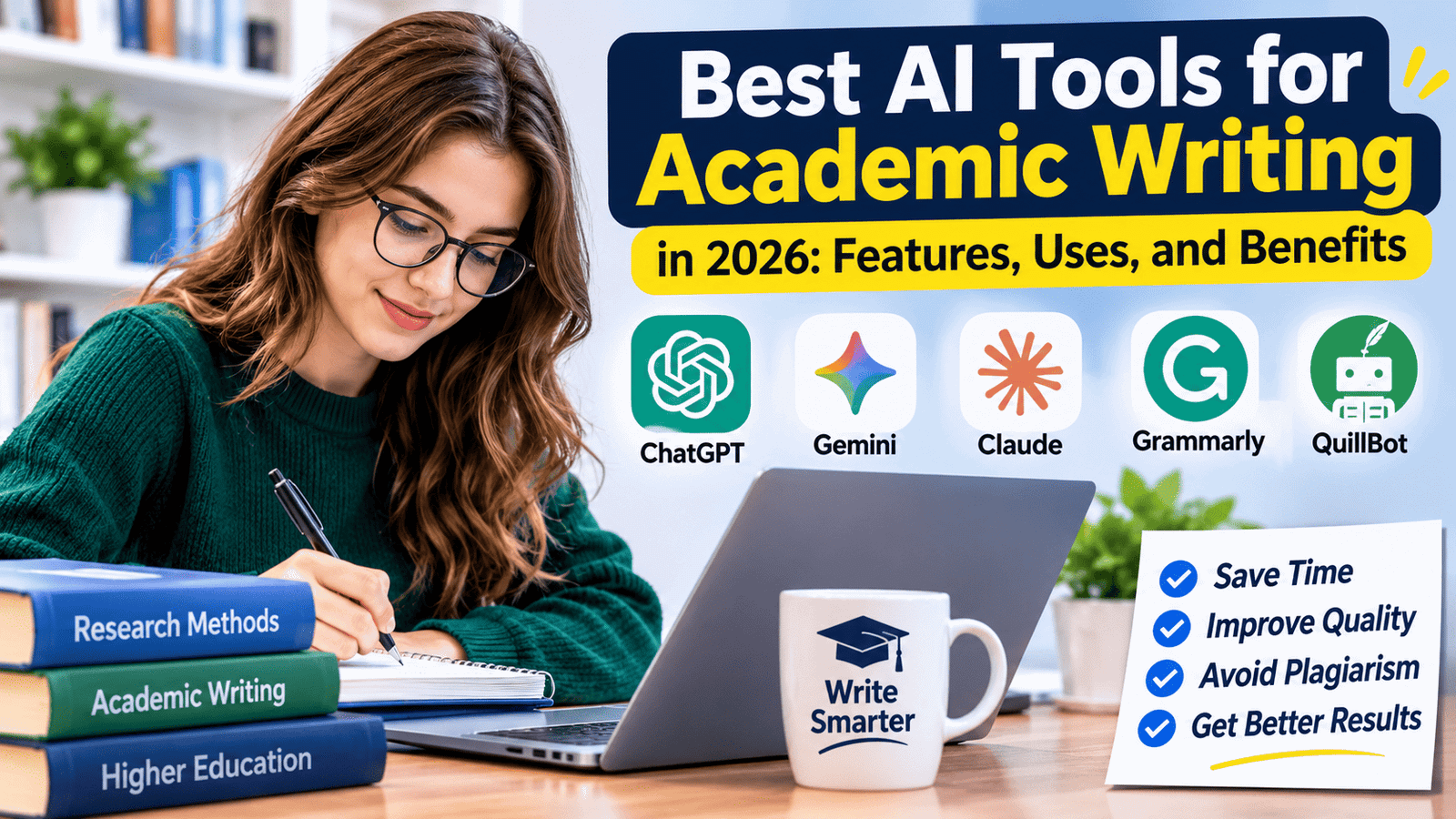
Academic writing requires more than putting information into paragraphs. Students, researchers, and university scholars must understand complex subjects, evaluate reliable sources, organise arguments, maintain academic language, and follow specific referencing styles. These responsibilities can make research papers, dissertations, essays, and journal submissions time-consuming.
Modern artificial intelligence has introduced new ways to support this process. AI tools for academic writing can help users explore research topics, understand published studies, improve sentence clarity, organise ideas, and identify language errors. Some platforms focus on finding scientific evidence, while others specialise in grammar correction, academic vocabulary, and research organisation.
However, not every AI writing platform offers the same capabilities. A tool that works well for correcting grammar may not be suitable for reviewing scientific literature. Similarly, a general AI chatbot may help organise an argument but should not automatically be trusted to produce accurate academic references.
This guide explores the best AI tools for academic writing in 2026, explains their main features, compares their practical uses, and discusses how to use them responsibly without compromising research quality or academic integrity.
What Are AI Tools for Academic Writing?
AI tools for academic writing are software applications that use artificial intelligence and language-processing technologies to support different stages of academic work. They can assist with research discovery, reading comprehension, writing improvement, proofreading, summarisation, and document organisation.
Some platforms analyse academic publications and help users identify relevant research. Others examine written content to detect grammatical mistakes, improve readability, and suggest more appropriate academic expressions.
For example, a student researching environmental sustainability might use an AI research assistant to discover relevant studies, a document-analysis platform to understand complicated findings, and an academic editing tool to improve sentence structure.
These applications are designed to support the writing process rather than replace independent thinking. The writer remains responsible for interpreting evidence, developing original arguments, checking references, and producing the final work.
10 Best AI Tools for Academic Writing in 2026
Different academic tasks require different software. The following platforms offer useful features for research discovery, writing assistance, editing, and reference management.
1. ChatGPT – Versatile Academic Writing Assistance
ChatGPT is a general-purpose AI assistant that can support several stages of academic writing. It can help users understand unfamiliar concepts, organise research questions, develop essay outlines, explain difficult terminology, and improve the clarity of existing paragraphs.One useful feature is its ability to adapt explanations to different knowledge levels. Someone studying a complicated scientific subject can request a simpler explanation before consulting the original research.
ChatGPT can also provide feedback on paragraph organisation, identify unclear arguments, and suggest questions that may strengthen a research discussion.Its flexibility makes it useful across different academic subjects. However, users should independently verify factual statements, quotations, statistics, and references. AI-generated citations should never be accepted without checking that the original publications actually exist.
Best for: Brainstorming, outlining, explanations, and writing feedback.
2. Grammarly – Grammar and Language Improvement
Grammarly focuses on improving written communication through grammar, spelling, punctuation, and clarity suggestions.Academic documents often contain complicated sentences, repeated expressions, and language mistakes that can make an argument difficult to understand. Grammarly helps identify these problems and offers suggestions for improving readability.
It can also help writers maintain a consistent tone throughout essays, reports, and research documents.Its main advantage is accessibility. Users can apply its writing assistance across different types of documents rather than learning a specialised academic platform.However, Grammarly is primarily a language-improvement tool. It does not replace subject knowledge, evidence evaluation, or proper academic research.
Best for: Grammar correction, proofreading, and sentence clarity.
3. Paperpal – Academic Editing and Research Writing
Paperpal is designed specifically around academic and scholarly writing. Its features support researchers who want to improve manuscript language, sentence structure, and overall readability.Unlike general-purpose writing assistants, Paperpal focuses on academic communication. It can help identify language problems, suggest clearer expressions, and support the preparation of research documents.It is particularly relevant when preparing manuscripts for academic journals, where consistent terminology and professional language are important.Writers should still review every suggested change carefully. A sentence can become grammatically smoother while losing an important technical meaning.
Best for: Academic editing, manuscript preparation, and language refinement.
4. Elicit – Research Discovery and Literature Reviews
Elicit is an AI-powered research assistant that helps users discover and analyse academic papers.Finding relevant studies is often one of the most demanding parts of academic writing. Researchers may need to examine numerous publications before identifying the evidence that supports their research questions.
Elicit helps organise this process by finding relevant papers and extracting information from research publications.It can be useful when exploring a new topic, comparing study findings, and developing an initial understanding of an academic research area.However, its results should be treated as a starting point. Researchers should read important original papers and check whether the extracted information accurately represents the authors’ findings.
Best for: Literature discovery, research screening, and evidence organisation.
5. Consensus – Evidence-Based Academic Searching
Consensus is a research-focused search platform that helps users explore questions through published scientific studies.Instead of relying entirely on general internet results, it focuses on academic literature and presents research-based information.This can be useful when investigating questions that require evidence from scientific publications. For example, someone studying sleep patterns might use Consensus to explore what published research says about sleep duration and cognitive performance.The platform can help identify relevant studies and provide an initial overview of research findings.Nevertheless, individual papers may reach different conclusions because of differences in research methods, participant groups, and study limitations. Users should examine the original evidence before making strong claims.
Best for: Research questions, scientific evidence discovery, and initial literature exploration.
6. SciSpace – Understanding Complex Research Papers
SciSpace helps users explore and understand academic research publications.Research papers frequently contain specialised terminology, complicated explanations, statistical information, and technical methods. These elements can create difficulties for readers who are new to a particular subject.SciSpace provides tools for exploring research papers and understanding difficult sections through AI-assisted explanations.It can be useful for identifying a paper’s research question, methodology, findings, and important terminology.However, simplified explanations should not replace reading the original publication. Technical details and limitations can sometimes be lost when complicated research is summarised.
Best for: Understanding research papers and exploring scientific terminology.
7. Jenni AI – Academic Drafting Assistance
Jenni AI is an academic writing assistant that supports drafting and organising written content.It can help users develop initial ideas, expand outlines, and maintain writing momentum when working on lengthy academic documents.For example, a researcher who has already developed a clear argument may use a writing assistant to explore alternative ways of expressing a particular idea.Its usefulness depends on the quality of the original research and the writer’s ability to review the generated suggestions.AI-generated paragraphs should never be treated as verified academic evidence. Every claim needs appropriate support from genuine sources.
Best for: Draft development, writing organisation, and idea exploration.
8. Writefull – Academic Language and Scientific Editing
Writefull is designed to support academic and scientific writing through language feedback and editing features.It is particularly relevant to researchers who regularly prepare technical documents, journal manuscripts, and scientific papers.Academic writing has different language expectations from everyday communication. Expressions that sound natural in casual conversation may not be suitable for a scientific explanation.Writefull helps writers examine their language and improve the presentation of academic content.Its integration with academic writing environments, including Overleaf, also makes it relevant to users working with LaTeX documents.
Best for: Scientific writing, academic language, and LaTeX-based documents.
9. QuillBot – Paraphrasing and Writing Clarity
QuillBot offers writing assistance through paraphrasing, grammar checking, and summarisation features.It can help writers explore alternative sentence structures and improve the readability of existing text.For academic users, its paraphrasing capabilities may be useful when reviewing their own notes and refining explanations.However, changing words does not make an idea original or remove the need for attribution. When information comes from another author’s research, the original source must still be acknowledged.Writers should also check that paraphrased sentences preserve the intended meaning.
Best for: Sentence restructuring, paraphrasing support, and writing clarity.
10. Zotero – Academic Reference Management
Zotero is a reference-management platform that helps researchers collect, organise, and cite academic sources.Although it is not primarily an AI writing assistant, it plays an important role in the academic writing process.Researchers often work with dozens or hundreds of publications. Keeping track of authors, publication dates, journal names, and other bibliographic details can become difficult without an organised system.Zotero helps users save research materials, organise references, and generate citations and bibliographies in supported styles.Its main value is reference organisation rather than generating academic arguments or writing complete research papers.
Best for: Reference management, citation organisation, and bibliographies.
Comparison of the Best AI Tools for Academic Writing
Choosing the right platform becomes easier when its main purpose is understood. The following comparison highlights the primary use of each tool.
| AI Tool | Main Purpose | Suitable For |
| ChatGPT | General AI assistance | Outlines and explanations |
| Grammarly | Language improvement | Grammar and proofreading |
| Paperpal | Academic editing | Research manuscripts |
| Elicit | Research discovery | Literature reviews |
| Consensus | Evidence searching | Scientific questions |
| SciSpace | Paper understanding | Research comprehension |
| Jenni AI | Drafting assistance | Organising written ideas |
| Writefull | Academic language editing | Scientific documents |
| QuillBot | Paraphrasing assistance | Sentence improvement |
| Zotero | Reference management | Citations and sources |
No single platform covers every academic requirement. Some tools are better for finding research, while others are more useful for editing and managing references.
How AI Tools Can Improve the Academic Writing Process
AI can support academic work in several practical ways. Its value is greatest when it addresses a specific writing problem rather than attempting to complete the entire assignment.
Research Topic Development
Choosing a suitable research topic is an important first step. AI assistants can help users explore possible research questions, identify related concepts, and understand different approaches to a subject.For example, a broad topic such as renewable energy can be divided into more focused areas, including solar energy adoption, environmental effects, and renewable energy policies.The researcher must decide which question is meaningful and supported by available evidence.
Literature Review Assistance
A literature review requires researchers to examine existing studies and understand how different publications relate to one anotherResearch platforms such as Elicit and Consensus can help identify potentially relevant papers and organise preliminary findings.However, a strong literature review involves more than collecting summaries. Researchers must compare methodologies, recognise disagreements, identify research gaps, and explain how previous studies relate to their own questions.
Academic Grammar and Proofreading
Grammar and sentence structure influence how clearly research findings are communicated.Writing tools can identify spelling mistakes, punctuation problems, unclear expressions, and unnecessarily complicated sentences.This assistance can be particularly helpful for writers who are working in an additional language.Nevertheless, editing suggestions should be reviewed to ensure that important subject-specific terminology remains accurate.
Research Organisation
Academic projects frequently involve multiple documents, notes, references, and research questions.AI-assisted platforms can help organise information and make it easier to identify relevant material.Reference-management software such as Zotero adds another layer of organisation by keeping research sources and bibliographic information together.
Understanding Difficult Academic Concepts
Some academic publications are difficult to understand without previous knowledge of the subject.AI assistants can explain unfamiliar terminology, summarise complicated passages, and suggest questions for further investigation.These explanations can make initial reading easier, but important conclusions should always be checked against the original research.
How to Choose the Right AI Tool for Academic Writing
Selecting academic writing software should begin with identifying the problem that needs to be solved.
For research discovery: Elicit and Consensus are useful starting points for finding academic publications and exploring evidence-based questions.
For grammar and proofreading: Grammarly can help improve everyday academic writing, while Paperpal and Writefull offer more specialised academic editing support.
For understanding research papers: SciSpace can help readers explore complicated publications and technical terminology.
For drafting and brainstorming: ChatGPT and Jenni AI can assist with developing outlines, organising ideas, and exploring alternative explanations.
For reference management: Zotero helps organise research materials and prepare bibliographies.
Before choosing a platform, consider its available features, free usage limits, compatibility with your writing software, privacy settings, and institutional requirements.A free plan may be sufficient for occasional proofreading or basic research exploration. More demanding projects may require additional features, but paying for several overlapping subscriptions is not always necessary.
Are AI Tools for Academic Writing Free?
Many academic writing platforms provide free access with certain limitations. These restrictions may involve the number of searches, editing suggestions, documents, or advanced features available.For example, Grammarly, ChatGPT, Elicit, Consensus, and Writefull offer forms of limited or free access, although their available features differ.Some specialised platforms also offer paid subscriptions for users who need additional research capacity or advanced editing functions.It is important to check official pricing pages before purchasing a subscription because prices, usage limits, and available features can change.Students should also consider whether their educational institution provides access to academic software through a library or university account.
Advantages of Using AI in Academic Writing
When used appropriately, AI writing assistance can provide several benefits.
- Time management: Research and editing assistance can reduce time spent on repetitive tasks.
- Improved readability: Grammar and editing tools can identify unclear sentences and language mistakes.
- Research exploration: Academic search platforms can help users discover relevant publications.
- Better organisation: AI-assisted workflows can help organise research notes and writing ideas.
- Learning support: Explanations of unfamiliar terminology can make complicated subjects easier to approach.
- Language development: Writing feedback can help users recognise recurring language problems and improve their academic communication.
These advantages depend on how the tools are used. AI assistance is most effective when combined with independent research, careful reading, and critical evaluation.
Limitations and Risks of AI Academic Writing Tools
Despite their advantages, AI platforms have important limitations that academic users should understand.
Inaccurate Information and Fabricated References
AI-generated responses can contain incorrect facts, misleading explanations, and references to publications that do not exist.This is particularly important when preparing research papers. A reference should never be included simply because an AI tool has provided an author name, journal title, or publication date.Always locate the original publication and confirm its details.
Academic Integrity Concerns
Universities and educational institutions have different policies regarding AI assistance.Some allow limited support for brainstorming and proofreading, while others impose restrictions on generating or editing assessed work.Submitting AI-generated material as independent work without permission or required disclosure may violate academic integrity rules.Students should review their course requirements and ask their instructors when the permitted uses are unclear.
Loss of Original Thinking
Relying too heavily on AI can reduce opportunities to develop independent research and analytical skills.Academic writing requires writers to evaluate evidence, question assumptions, compare arguments, and reach their own conclusions.AI should support these activities rather than replace them.
Privacy and Research Confidentiality
Not every AI platform is appropriate for confidential academic material.Before uploading unpublished research, personal information, interview transcripts, or institutional documents, review the platform’s privacy policy and data-handling settings.Researchers should follow their institution’s confidentiality and data-protection requirements.
How to Use AI Tools Responsibly in Academic Writing
Responsible use begins with understanding the difference between assistance and authorship.
A practical approach is to use AI for clearly defined tasks while keeping research decisions and final academic arguments under your control.
- Start with original research: Develop your research question and identify reliable publications before relying on AI-generated explanations.
- Use tools for specific tasks: Select a research assistant for literature discovery and an editing tool for language improvement.
- Check every important claim: Compare factual statements with original publications and authoritative sources.
- Verify references: Confirm authors, publication titles, journal details, dates, and identifiers independently.
- Maintain your own argument: Use AI suggestions to improve clarity without surrendering your interpretation of the evidence.
- Follow institutional rules: Check whether AI assistance must be acknowledged or disclosed.
- Protect confidential information: Avoid uploading sensitive research material to services without appropriate permission.
This approach helps maintain transparency while allowing researchers to benefit from useful technological assistance.
Future of AI in Academic Writing
AI is likely to become increasingly integrated into academic research and writing workflows.Research discovery, document analysis, language editing, and reference organisation are already areas where specialised software provides practical assistance.Future developments may make it easier to compare larger collections of publications, explore connections between research findings, and identify inconsistencies in academic documents.
However, technological improvements will not remove the need for critical thinking and independent verification.Academic quality still depends on reliable evidence, original analysis, appropriate methodology, and clear communication. AI can make parts of this process more manageable, but the responsibility for the final work remains with the researcher.
Frequently Asked Questions
1. What are the best AI tools for academic writing in 2026?
Some useful options include ChatGPT, Grammarly, Paperpal, Elicit, Consensus, SciSpace, Jenni AI, Writefull, QuillBot, and Zotero. Each serves a different purpose, from research discovery and proofreading to reference management.
2. Which AI tool is best for writing research papers?
There is no single best option for every research paper. ChatGPT can support brainstorming and organisation, Paperpal and Writefull can assist with academic language, while Elicit and Consensus can help researchers discover relevant studies.
3. Are AI tools for academic writing free?
Several platforms offer free access with usage restrictions. Available features and limits vary, so users should check the current plans before choosing a service.
4. Can AI tools help with literature reviews?
Yes. Research assistants such as Elicit and Consensus can help identify relevant publications and organise preliminary information. Researchers must still read and evaluate original studies before developing their literature reviews.
5. Can AI generate academic references?
Some platforms offer citation-related features, but AI-generated references can contain errors or fabricated publication details. Verify every reference using the original publication or a reliable academic database.
6. Is using AI for academic writing considered cheating?
Not necessarily. The answer depends on institutional rules and the specific task. Brainstorming, proofreading, and research support may be permitted, while submitting AI-generated work as your own may violate academic integrity policies.
7. How can students use AI without compromising academic integrity?
Students should use AI for permitted support tasks, verify information independently, develop their own arguments, acknowledge AI assistance when required, and follow their institution’s assessment guidelines.
Conclusion
AI is changing how students and researchers approach academic writing, from discovering relevant publications to improving grammar and organising references. Platforms such as Elicit, Consensus, Paperpal, Grammarly, SciSpace, and ChatGPT provide different forms of assistance for these tasks.
The most effective approach is not to depend on one platform for everything. Instead, choose tools according to your research requirements, verify their outputs, and maintain control over your own analysis and writing.
Ultimately, AI tools for academic writing are most valuable when they support better research habits, clearer communication, and more organised academic work without replacing the knowledge, judgement, and originality of the writer.
 UploadWords.com