
Introduction
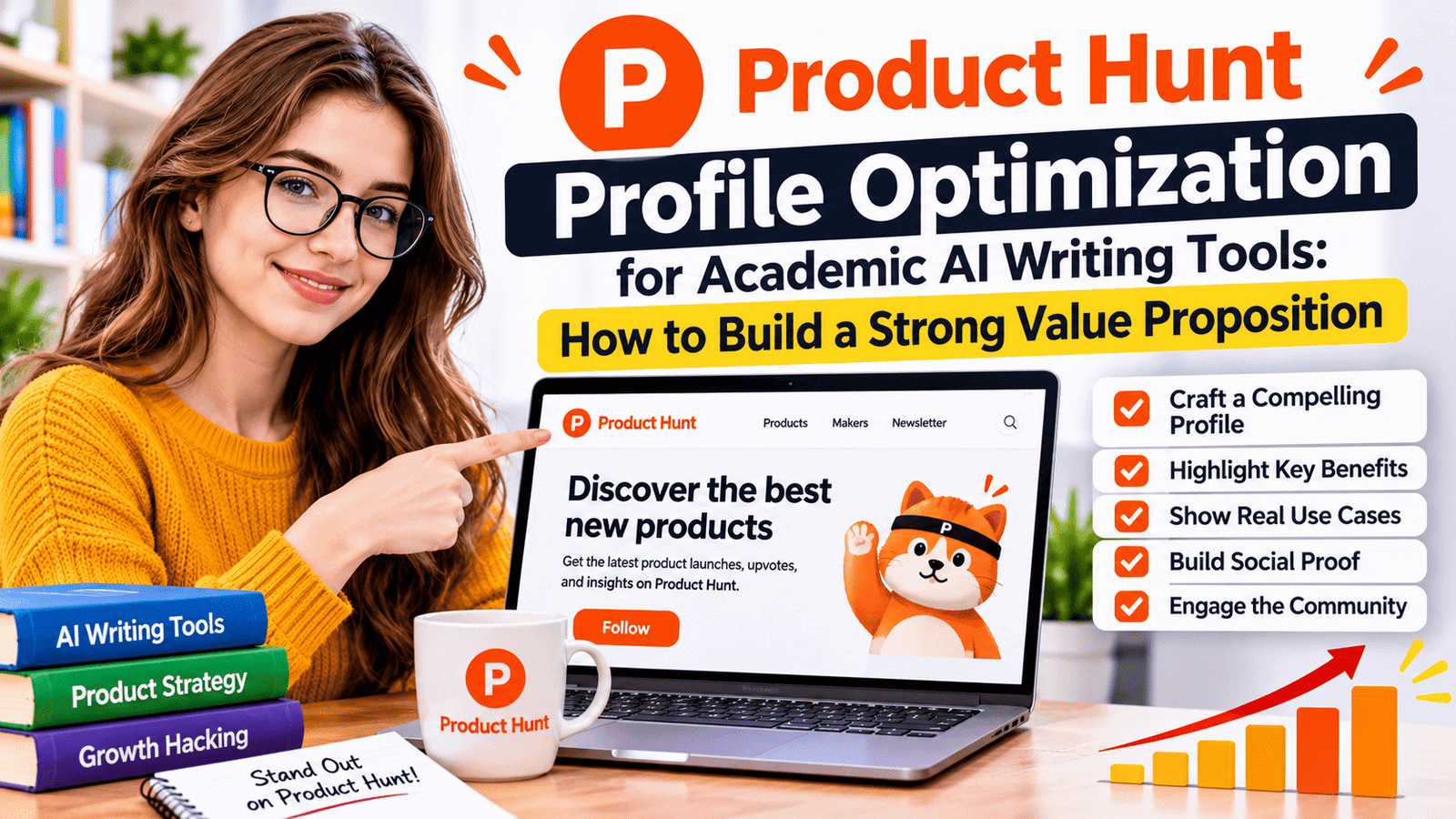
Launching an academic AI writing tool requires more than developing useful features and publishing a website. People need to understand what the product does, who it helps, and why they should choose it over other available solutions. This is where Product Hunt profile optimization becomes an important part of product marketing.
Product Hunt is a platform where makers introduce new digital products, connect with early adopters, and receive feedback from people interested in technology. For developers of academic AI writing tools, it provides an opportunity to present their software to students, researchers, educators, and professionals who regularly work with academic documents.
However, simply creating a profile and adding a product description is not enough. A successful presentation requires a clear value proposition, relevant product information, engaging visuals, and a practical explanation of the problems the tool solves.
Understanding product hunt profile optimization academic ai writing tool value proposition can help developers create a more convincing product identity and communicate the benefits of their software effectively.
What Is Product Hunt Profile Optimization?
Product Hunt profile optimization is the process of improving a maker’s personal profile and product presentation so visitors can quickly understand the people behind a product and the purpose of the software.For an academic AI writing tool, optimization involves presenting the product as a practical solution for academic writing challenges rather than describing it as another general-purpose AI assistant.
A well-prepared presence should communicate three important things:
- Product identity: What the academic AI writing tool does.
- Target audience: Whether it is designed for students, researchers, professors, or academic professionals.
- Main benefit: How it helps users improve their writing and research workflow.
The personal maker profile also matters. Product Hunt encourages makers to use personal accounts, complete their profiles, and participate in community discussions before launching.
This helps visitors understand who developed the software and gives them additional context about the team behind the product.
Why Academic AI Writing Tools Need a Clear Value Proposition
The academic AI software market includes tools for proofreading, paraphrasing, literature discovery, summarization, citation assistance, and research organization.Because many products offer overlapping features, developers need to explain what makes their particular solution useful.A value proposition is a short explanation of the specific benefits a product provides to its intended audience. It should connect a real user problem with a practical solution.
For example, instead of describing a product as an advanced AI-powered writing platform, a developer could explain that it helps researchers organize academic sources, improve sentence clarity, and manage citations while preparing research documents.
This communicates a more meaningful benefit.
A strong value proposition should answer the following questions:
- What problem does the software solve?
- Who is most likely to benefit from it?
- Which features address that problem?
- What makes the product different from alternative tools?
- Why should someone try it?
These answers should remain consistent across the Product Hunt profile, product description, website, and launch materials.
How to Optimize a Product Hunt Profile for an Academic AI Writing Tool
1. Create a Professional Maker Profile
Before introducing an academic AI writing product, developers should establish a complete and credible maker profile.A personal profile helps visitors understand who is responsible for developing the software. It should include a recognizable name, a professional headline, a relevant website, and appropriate social links.
The profile description should briefly explain the maker’s interests and involvement in developing academic technology.
For example:
“I build AI-powered tools that help students and researchers improve their academic writing, organize research, and work more efficiently.”
This description communicates the maker’s area of interest without making exaggerated claims.
2. Write a Clear and Descriptive Product Tagline
The tagline is one of the first elements visitors notice when discovering a product on Product Hunt.It should explain the product’s primary function without relying on vague marketing language.
For an academic AI writing tool, possible tagline examples include:
- AI writing assistance for students and researchers.
- Improve academic writing with research-focused AI.
- Simplify research, citations, and academic editing.
The best tagline depends on the product’s actual capabilities.
If the software primarily checks grammar, the tagline should emphasize academic proofreading. If it supports research discovery and citation management, those functions can become part of its positioning.Product Hunt currently allows a tagline of up to 60 characters, making clarity especially important.
3. Develop a Benefit-Focused Product Description
The product description should explain what the software does and why its intended audience might find it useful.Avoid filling this section with technical terminology that ordinary visitors may not understand.Instead, focus on the main problem, the solution, and the features that deliver the benefit.
Example product description:
“An AI-powered academic writing assistant that helps students and researchers improve drafts, refine language, summarize research materials, and organize citations while maintaining control over their original work.”
This description identifies the audience, explains the product’s purpose, and introduces its major functions.Developers should only mention features that are actually available in their software.
4. Highlight Features That Matter to Academic Users
A long list of AI capabilities does not automatically make a product attractive. Visitors want to understand how individual features support their academic work.
Some useful features to highlight include:
Academic proofreading: Helps identify grammar mistakes, spelling issues, unclear sentences, and inconsistent language.
Research summarization: Helps users understand lengthy research materials by producing concise summaries.
Citation assistance: Supports citation formatting and reference organization in recognized academic styles.
Writing improvement: Provides suggestions for improving clarity, sentence structure, and academic tone.
Document organization: Helps users manage drafts, research notes, and writing projects.
Research assistance: Supports the process of identifying relevant academic sources and organizing research information.
The strongest presentation connects each feature with a specific user benefit instead of simply repeating technical specifications.
Building a Strong Value Proposition for an Academic AI Writing Tool
A compelling value proposition should explain why the product deserves attention in a competitive software market.It should not promise that AI can replace academic knowledge, original research, or critical thinking. Instead, it should demonstrate how the software supports users throughout their writing process.
Identify the Main Audience
Different academic users have different requirements.
| Audience | Common Writing Challenges |
| University students | Organizing assignments and improving academic language |
| Researchers | Preparing manuscripts and managing references |
| PhD scholars | Reviewing literature and organizing research material |
| Professors | Preparing academic documents and reviewing written material |
| Academic professionals | Editing reports and improving document clarity |
A product may serve several audiences, but its Product Hunt presentation should identify the primary users first.This makes the marketing message more focused.
Explain the Main Problem
An effective value proposition begins with a problem that potential users recognize.For example, students may struggle to organize their ideas into structured academic paragraphs. Researchers may spend considerable time checking references and refining manuscript language.An academic AI writing assistant can address selected parts of these workflows by providing editing suggestions, research support, and organizational features.
The important point is to explain the actual problem rather than making broad claims about transforming education.
Show What Makes the Product Different
A developer should identify the product’s genuine competitive advantage.
Possible differentiators include:
- Research-focused writing assistance.
- Support for recognized citation styles.
- Source-linked research suggestions.
- Integration with document editors.
- Specialized academic editing features.
- Transparent AI-generated suggestions.
Not every product needs all these capabilities. A focused tool that performs one important task particularly well may have a stronger positioning than a platform that claims to do everything.
Product Hunt Visual Optimization and Presentation
Visual presentation plays an important role because visitors often examine screenshots before reading a complete product description.Academic AI writing tools should use screenshots that demonstrate real product functionality.
Useful visual materials include:
Dashboard screenshot: Shows the main interface and available writing features.
Editing demonstration: Shows how the software identifies unclear sentences and suggests improvements.
Research workflow: Demonstrates how users organize research materials or review academic sources.
Citation interface: Displays how reference formatting works.
Product demonstration video: Provides a short walkthrough of the main user experience.
Avoid using promotional graphics that look attractive but fail to demonstrate the actual software.Product Hunt recommends using at least one gallery image and identifies three or more images, a video, and a demo as useful ways to strengthen a launch presentation.
Writing a Compelling Product Hunt Maker Comment
The first maker comment is an important opportunity to introduce the product in a conversational way.Instead of repeating the product description, explain why the software was developed, which users it serves, and what kind of feedback would help improve it.
A practical structure includes:
- Introduce yourself and your development team.
- Explain the problem that inspired the product.
- Describe the main features.
- Identify the intended audience.
- Explain what makes the product different.
- Ask visitors for specific feedback.
Example Maker Comment:
“Hi Product Hunt community!
We created this academic AI writing assistant to help students and researchers manage some of the most time-consuming parts of academic writing.
The platform focuses on improving writing clarity, organizing research materials, and supporting citation workflows. Our goal is to make academic writing more manageable while keeping original thinking and user judgment at the center of the process.
We would love to hear your feedback. Which academic writing task would you most like to see improved in a tool like this?”This approach introduces the product naturally and encourages meaningful discussion.
Common Product Hunt Optimization Mistakes to Avoid
Even a useful academic AI writing tool can struggle to communicate its benefits if its product presentation is poorly structured.
Some common mistakes include:
Using vague taglines: Phrases such as “The future of writing” do not explain what the software actually does.
Listing too many features: An extensive feature list can distract visitors from the product’s primary benefit.
Ignoring the target audience: A product description aimed at everyone may fail to connect with its most valuable users.
Making unsupported claims: Avoid promises about guaranteed grades, perfect research accuracy, or automatic academic success.
Using misleading screenshots: Product visuals should represent real features and genuine user experiences.
Ignoring community feedback: Launching is an opportunity to learn from users, not simply promote a product.
Requesting artificial engagement: Product Hunt prohibits paid upvotes and artificial engagement practices. Genuine conversations and feedback are more valuable.
How to Measure the Success of Product Hunt Profile Optimization
Product Hunt optimization should not be evaluated only through leaderboard position.A product may receive useful feedback, attract interested users, and establish valuable industry connections without becoming Product of the Day.
Developers should monitor several indicators:
| Performance Indicator | What It Reveals |
| Product page visits | Interest in the product presentation |
| Website clicks | Visitors moving towards the actual software |
| Sign-ups | Interest in trying the product |
| User feedback | Strengths and weaknesses of the product |
| Feature requests | Unmet audience requirements |
| Returning users | Continued interest in the software |
Tracking these indicators helps developers understand whether their positioning communicates the intended value.It is also useful to compare website conversion rates before and after improving the product description, tagline, and visual presentation.
The Importance of Academic Integrity and Responsible AI Use
Academic AI writing tools should be positioned as writing and research assistants rather than replacements for students’ or researchers’ own work.
Their purpose should be to support learnng, improve communication, and make research workflows more organized.Developers should explain how their software handles uploaded documents, whether submitted content is stored, and how user information is protected.
Citation-related features should also be presented carefully. AI-generated references must be checked against their original publications because incorrect or fabricated citations can undermine academic work.Similarly, students should follow their institution’s rules regarding AI assistance and disclose its use whenever required.Responsible positioning can help an academic AI writing product build trust with its intended audience.
Conclusion
Product Hunt profile optimization is an important part of introducing an academic AI writing tool to potential users. A complete maker profile, clear tagline, informative product description, relevant screenshots, and engaging launch comment can help visitors understand the product’s purpose.
However, the most important element is a convincing value proposition. Developers should communicate the specific academic problems their software addresses, identify its primary audience, and demonstrate how its features provide practical support.
By focusing on clarity, genuine product benefits, transparent communication, and responsible AI use, developers can create a stronger Product Hunt presence and build meaningful relationships with students, researchers, and academic professionals.
Frequently Asked Questions
1. What is Product Hunt profile optimization?
Product Hunt profile optimization involves improving a maker’s personal profile and product presentation to communicate credibility, product purpose, and value to potential users.
2. Why is a value proposition important for an academic AI writing tool?
A value proposition explains the problems the software solves, identifies its intended audience, and communicates why users might choose it over alternative solutions.
3. What should an academic AI writing tool include in its Product Hunt description?
It should explain its main purpose, target audience, important features, and practical benefits. The description should remain clear and avoid unsupported marketing claims.
4. Which features should developers highlight?
Useful features may include academic proofreading, research summarization, citation assistance, writing improvement, document organization, and research support.
5. How can developers make an academic AI writing tool stand out?
They can focus on a specific academic audience, demonstrate genuine product capabilities, explain their competitive advantage, and use clear examples of real user workflows.
6. Does Product Hunt optimization guarantee a successful launch?
No. Optimization can improve product presentation and help visitors understand its value, but launch outcomes also depend on product quality, originality, community engagement, and user interest.
7. Why is responsible AI use important in academic writing software?
Responsible AI use protects academic integrity, encourages independent thinking, and helps users understand the limitations of AI-generated information and citations.
 UploadWords.com