

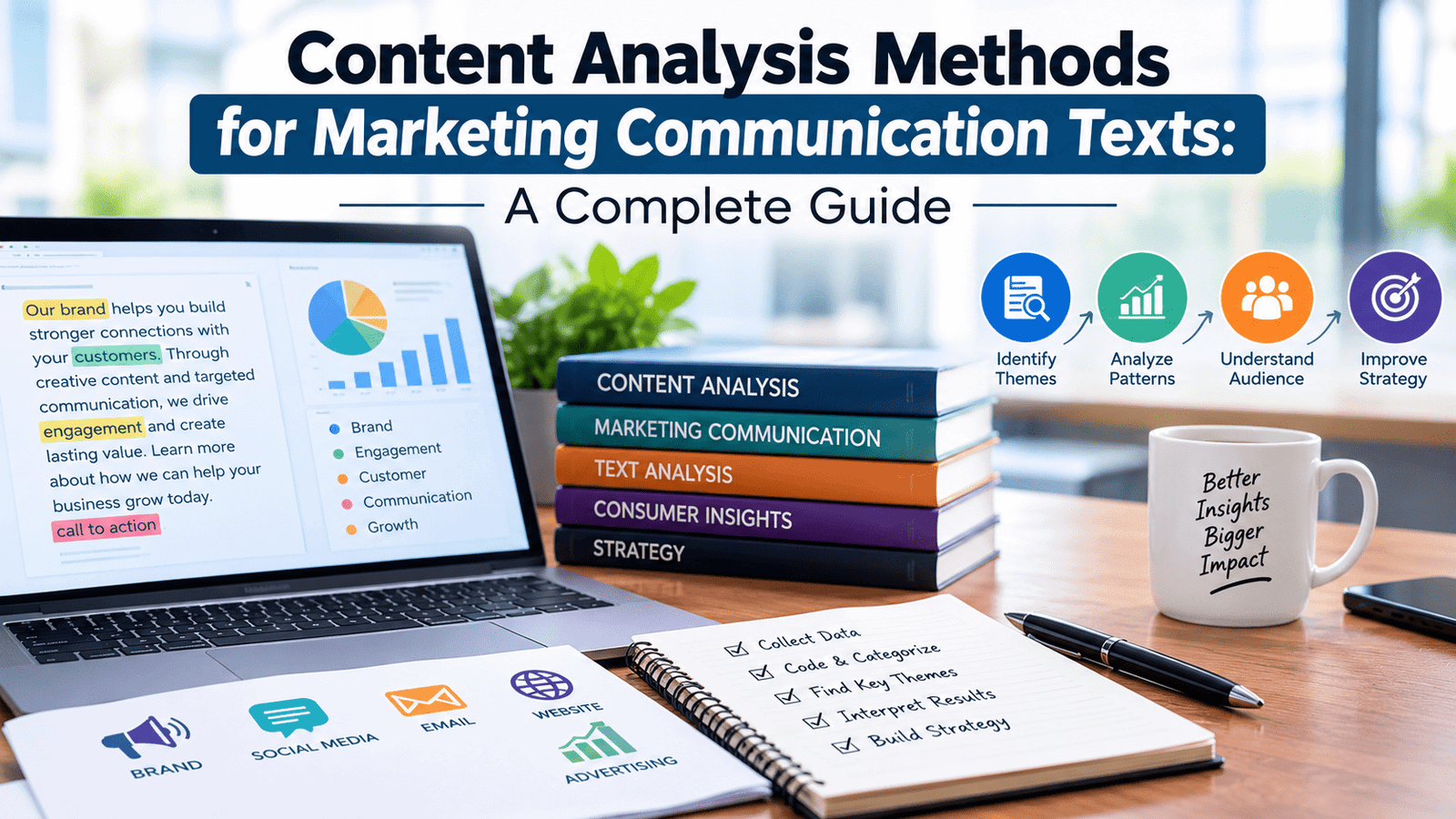
Content analysis methods for marketing communication texts are systematic research techniques used to examine advertising copy, social media posts, email campaigns, website content, brand messages, and other marketing materials. These methods help researchers identify recurring themes, measure word frequency, evaluate brand tone, compare promotional strategies, and understand how companies communicate with their audiences. The main approaches include quantitative content analysis, qualitative content analysis, thematic analysis, sentiment analysis, and automated text analysis. Researchers can use these techniques individually or combine them to obtain a more comprehensive understanding of marketing messages.
Introduction
Marketing communication involves more than promoting products or describing services. Every advertisement, email, social media caption, press release, and website headline communicates ideas about a brand, its values, and the benefits it offers to customers. Understanding these messages requires a structured approach to examining the language, themes, and persuasive techniques used in marketing materials.
This is where content analysis becomes valuable. It provides a systematic way to study communication texts, identify meaningful patterns, and evaluate how brands present themselves across different channels.
The study of content analysis methods for marketing communication texts is particularly useful for marketing researchers, communication students, advertising professionals, and businesses seeking evidence-based insights into their messaging strategies. Rather than relying entirely on personal opinions, researchers can classify messages, examine recurring characteristics, and compare communication approaches using clearly defined criteria.
This guide explains the principal methods, how they work, when to use them, and how to conduct a practical content analysis of marketing materials.
What Is Content Analysis in Marketing Communication?
Content analysis is a research method that systematically examines recorded communication to identify, classify, count, and interpret meaningful features. In marketing, the material being studied may include written advertisements, promotional emails, product descriptions, customer reviews, social media posts, brand slogans, and corporate announcements.
The central purpose is to understand what marketing messages contain and how their characteristics relate to a research question.
For example, a researcher might examine whether a group of skincare brands emphasizes product ingredients, affordability, convenience, sustainability, or customer satisfaction. By applying consistent coding rules to each advertisement, the researcher can compare the messages without relying solely on subjective impressions.
Content analysis can examine two broad levels of meaning:
- Manifest content: The directly observable elements of a message, such as specific words, product names, prices, calls to action, and promotional claims.
- Latent content: The underlying meaning or implication of a message, such as its implied emotional appeal, positioning strategy, or representation of customer needs.
Both levels can be useful. Counting the word “free” is relatively straightforward, whereas interpreting whether an advertisement communicates reassurance or exclusivity requires greater judgment.
A well-designed study clearly explains which elements it examines and how its conclusions are supported by the evidence.
Main Content Analysis Methods for Marketing Communication Texts
Different methods answer different research questions. The most appropriate choice depends on the material being examined, the purpose of the study, the available resources, and whether the researcher needs numerical measurements, interpretive insights, or both.
1. Quantitative Content Analysis
Quantitative content analysis focuses on counting and measuring identifiable features within communication texts. Researchers create a coding framework, apply it consistently, and use numerical results to identify patterns.
For instance, a study might examine 200 online advertisements and record how many mention discounts, free delivery, product quality, sustainability, or customer reviews.
The results can reveal which messages appear most frequently and whether communication patterns differ between brands or platforms.
Common variables include:
- Frequency of specific words and phrases.
- Presence or absence of promotional offers.
- Number of product benefits mentioned.
- Frequency of emotional or rational appeals.
- Use of calls to action.
- Distribution of content across marketing channels.
Quantitative analysis is especially appropriate when researchers want to compare large collections of advertisements or measure changes over time.
However, frequency alone does not establish effectiveness. A brand may mention a discount repeatedly without persuading more customers to purchase. Connecting content characteristics to actual marketing outcomes requires additional evidence, such as campaign performance data or experimental research.
2. Qualitative Content Analysis
Qualitative content analysis examines the meaning and context of marketing messages. Instead of concentrating primarily on numerical counts, researchers classify text into meaningful categories and explain how messages communicate particular ideas.
Consider a company promoting environmentally friendly household products. Its advertisements might discuss recyclable packaging, reduced waste, responsible sourcing, and long-lasting product design.
A qualitative analysis would examine how these ideas are expressed, which benefits receive the most attention, and how the company presents its environmental commitments.
This method is useful for studying:
- Brand identity and positioning.
- Persuasive language and rhetorical techniques.
- Representations of customers and their needs.
- Explanations of product value.
- Emotional appeals and storytelling.
- The relationship between claims and supporting information.
Researchers may develop categories before analyzing the material or allow categories to emerge as they examine the texts. The chosen approach should be documented so readers can understand how interpretations were reached.
Qualitative content analysis is particularly valuable when marketing messages contain contextual meanings that cannot be adequately represented through word counts alone.
3. Thematic Analysis
Thematic analysis identifies recurring patterns of meaning across a collection of texts. Although it overlaps with qualitative content analysis, its principal emphasis is on developing and interpreting themes rather than systematically measuring predefined categories.
Suppose a researcher collects customer testimonials from several online retailers. Repeated themes might include convenience, affordability, product reliability, customer support, and delivery experience.
The researcher reviews the material, assigns initial codes, groups related codes, and develops broader themes that help answer the research question.
In marketing communication research, thematic analysis can help explain:
- How brands describe customer problems.
- Which benefits dominate promotional storytelling.
- How customer testimonials represent trust.
- How campaigns discuss lifestyle and identity.
- Which concerns appear repeatedly in brand communications.
A theme should capture a meaningful pattern rather than simply represent a frequently occurring word. For example, several different expressions might communicate the broader theme of convenience without using the word itself.
Thematic analysis is useful when the research objective is to understand recurring meanings and relationships across messages rather than produce a frequency-based classification alone.
4. Sentiment Analysis
Sentiment analysis uses linguistic rules, statistical models, or machine-learning systems to classify text according to expressed sentiment, commonly positive, negative, or neutral.
In marketing, it is frequently applied to customer reviews, social media discussions, product feedback, and brand-related comments.
For example, a company analyzing customer feedback might identify positive comments about product quality, negative comments about delivery delays, and neutral comments that simply describe product features.
This can help marketing teams identify communication issues and understand how customers discuss particular products or services.
Nevertheless, sentiment analysis requires careful interpretation. Sarcasm, mixed opinions, cultural differences, and industry-specific vocabulary can produce misleading classifications. A negative review may also concern a delivery company rather than the product itself.
For research involving marketing communication texts, sentiment analysis should therefore be validated against manually reviewed examples, particularly when the results will support important decisions.
5. Comparative Content Analysis
Comparative content analysis examines similarities and differences between two or more groups of communication materials.
Researchers may compare competing brands, advertising platforms, campaign periods, target audiences, or communication formats.
For example, a study could compare how three smartphone brands describe their products. One may emphasize technical specifications, another may highlight photography and creativity, while a third may focus on affordability and reliability.
A comparison could examine:
- Brand positioning and key selling points.
- Promotional language and tone.
- Emotional versus rational appeals.
- Customer benefits and product features.
- Calls to action and promotional incentives.
- Differences between website and social media messaging.
The method is most informative when the groups are selected according to a clear research question and analyzed using the same coding definitions.
Comparisons also require attention to context. An Instagram caption and a detailed product page serve different purposes, so differences in message length or vocabulary should not automatically be interpreted as differences in brand strategy.
6. Automated and Computational Text Analysis
Automated text analysis applies computational techniques to large collections of marketing texts. Depending on the research question, it may involve word-frequency analysis, keyword extraction, topic modeling, language classification, or machine-learning-based coding.
These techniques can help researchers process thousands of product descriptions, promotional emails, or social media posts more efficiently than manual examination alone.
For example, a researcher studying a large collection of retail advertisements might use software to identify recurring product-benefit terms and then examine how those terms vary across brands.
Automated analysis can support:
- Keyword and phrase frequency measurement.
- Identification of recurring topics.
- Classification of marketing messages.
- Comparison of vocabulary between brands.
- Detection of changes in communication over time.
- Initial screening of large text collections.
Tools may include spreadsheets, qualitative research software, statistical programming environments, and natural language processing systems.
Automation does not remove the need for methodological judgment. Researchers must address text quality, duplicated content, classification errors, and the possibility that a software model may misunderstand context. Important findings should be checked against the original material.
Comparison of Content Analysis Methods
The following table summarizes the main methods and their typical applications.
| Method | Primary focus | Example in marketing |
| Quantitative content analysis | Counts and measurable categories | Measuring how often advertisements mention discounts |
| Qualitative content analysis | Meaning and context | Examining how a brand communicates reliability |
| Thematic analysis | Recurring patterns of meaning | Identifying common themes in customer testimonials |
| Sentiment analysis | Expressed positive, negative, or neutral sentiment | Classifying customer comments about a campaign |
| Comparative content analysis | Differences and similarities | Comparing promotional strategies across brands |
| Automated text analysis | Computational examination of text | Identifying recurring topics across thousands of posts |
These approaches are not necessarily mutually exclusive. A research project can combine numerical coding with qualitative interpretation or use automated tools to support a manually validated analysis.
How to Conduct Content Analysis of Marketing Communication Texts
A rigorous study follows a transparent process. The exact procedure varies according to the method, but the following steps provide a practical framework.
Step 1: Define the Research Objective
Begin with a clear question that determines what the analysis should investigate.
Examples include:
- How do competing brands communicate product quality in online advertisements?
- Which persuasive appeals appear most frequently in promotional emails?
- How has a company’s brand messaging changed over a defined period?
- How do social media posts communicate sustainability claims?
A focused research question helps prevent the project from collecting unnecessary material or creating categories that do not contribute to the study.
Step 2: Select the Marketing Communication Texts
Determine which materials will be included in the analysis. The dataset might contain website pages, advertising copy, social media captions, email campaigns, product descriptions, or customer-facing announcements.
Specify the brands, platforms, dates, languages, and other relevant selection criteria.
Researchers should explain how the texts were collected and why they represent the material needed to answer the research question. If only a sample is analyzed, the sampling process should be documented.
For example, a study might examine publicly available promotional posts from five brands over a three-month period. The researchers would need to define which posts qualify and how missing or duplicated items are handled.
Step 3: Choose the Unit of Analysis
The unit of analysis is the item or segment to which coding decisions are applied. Choosing the wrong unit can make the findings difficult to interpret.
Common units include:
- Word: An individual term, such as “premium.”
- Phrase: A short expression, such as “free home delivery.”
- Sentence: A complete sentence communicating a benefit or claim.
- Paragraph: A longer section of explanatory or promotional text.
- Document: A complete advertisement, email, or webpage.
- Theme: A meaningful concept expressed within one or more text segments.
A study comparing complete advertisements may use each advertisement as its primary unit while also recording individual claims within it.
The unit must be clearly defined so different coders know exactly what they are evaluating.
Step 4: Develop a Coding Framework
A coding framework specifies the categories used to classify the material. Each category should have a clear definition and rules for deciding when it applies.
For a study of promotional advertisements, a basic framework could include the following categories:
| Category | What the researcher records | Example |
| Price appeal | Emphasis on cost or savings | “Save 20% today” |
| Quality appeal | Emphasis on quality or durability | “Designed for everyday use” |
| Emotional appeal | Language intended to evoke feelings | “Make every moment special” |
| Social proof | Reference to customer approval | “Rated highly by customers” |
| Sustainability | Environmental claims or benefits | “Packaging made with recycled materials” |
| Call to action | A direct invitation to act | “Explore the collection” |
These examples are illustrative categories, not universal rules. Researchers should adapt them to their objectives and define how overlapping categories are handled.
A single advertisement may legitimately contain several categories. The coding instructions should make this possibility explicit.
Step 5: Pilot the Coding Framework
Before analyzing the full dataset, test the framework on a small subset of texts.
The pilot helps identify ambiguous definitions, missing categories, and situations in which different researchers interpret the same message differently.
For example, coders may disagree about whether “Discover a better way to shop” represents an emotional appeal, a convenience claim, or simply a call to action.
The framework can be revised during the pilot, with changes documented. For a quantitative study using a fixed coding scheme, the final definitions should be established before the main coding process begins.
Step 6: Code the Material Consistently
Apply the finalized rules to the selected texts. Depending on the project, this can be done manually, with qualitative analysis software, or through automated classification.
Record relevant observations in a structured dataset. Each row might represent an advertisement, while columns record the brand, publication date, platform, message length, and presence of specific categories.
When interpretation is required, retain examples from the original texts so findings can be traced back to the evidence.
Step 7: Check Reliability and Validity
Reliability concerns whether coding decisions are sufficiently consistent. In studies with multiple coders, researchers should independently code a suitable subset of the material and assess their agreement.
Depending on the data and design, appropriate measures may include Cohen’s kappa or Krippendorff’s alpha. The selected statistic should match the coding arrangement and measurement level.
Validity concerns whether the categories and procedures adequately represent the concepts the study intends to investigate.
For example, counting the word “trusted” does not necessarily establish that an advertisement successfully builds trust. It only measures the presence of that word unless additional evidence supports a broader conclusion.
Clear definitions, pilot testing, independent coding, and transparent reporting strengthen the credibility of the results.
Step 8: Analyze and Interpret the Findings
Once coding is complete, summarize the results in relation to the research question.
Quantitative studies may report frequencies, percentages, cross-tabulations, or relationships between coded categories. Qualitative studies may explain how different messages communicate themes, brand values, or persuasive strategies.
Researchers should distinguish observed patterns from explanations of why those patterns occurred.
For example, discovering that one brand mentions affordability more often than its competitors does not establish that its strategy is more successful. Performance data or a separate research design would be needed to evaluate that claim.
Step 9: Present the Results Clearly
The final report should explain the research question, sample selection, unit of analysis, coding framework, analytical procedure, reliability checks, limitations, and major findings.
Use tables or charts when they help readers understand the evidence. Include representative examples where appropriate, and explain why the findings matter for marketing communication research.
A transparent report allows other researchers to evaluate the conclusions and, where feasible, reproduce the procedure.
Practical Example: Analyzing Three Marketing Advertisements
Consider a hypothetical study examining advertisements from three fictional clothing brands. The researcher wants to identify which communication appeals each brand uses.
| Advertisement | Price appeal | Quality appeal | Emotional appeal | Call to action |
| Brand A | Yes | Yes | No | Yes |
| Brand B | No | Yes | Yes | Yes |
| Brand C | Yes | No | Yes | Yes |
| Total | 2 of 3 | 2 of 3 | 2 of 3 | 3 of 3 |
Note: These figures are illustrative and do not represent findings from a real marketing study.
The results show that all three advertisements contain a call to action, while price, quality, and emotional appeals each appear in two advertisements.
This basic analysis helps describe the sample, but it does not establish which brand communicates most effectively. The researcher would need additional evidence, such as audience responses, conversion data, or a controlled experiment, to evaluate effectiveness.
The example demonstrates how a clearly defined coding framework turns promotional text into structured information that can be compared and interpreted.
Why Content Analysis Matters in Marketing Research
Content analysis provides several benefits when researchers need to understand communication materials systematically.
Understanding Brand Positioning
The method can reveal which product benefits, values, and customer needs a brand emphasizes. Researchers can compare those messages with competitors’ communications to identify similarities and differences in positioning.
Evaluating Advertising Strategies
Analyzing promotional language helps researchers understand how advertisements combine informational claims, emotional appeals, social proof, and calls to action.
These observations can inform further research into how audiences respond to different messages.
Studying Digital Communication
Marketing communication now appears across websites, social networks, email campaigns, online reviews, and other digital channels. Content analysis offers a structured approach to studying these different forms of recorded communication.
When materials from multiple platforms are compared, researchers should account for differences in format, audience, and purpose.
Identifying Changes Over Time
Researchers can compare communication texts from different periods to examine changes in brand language, promotional priorities, product positioning, or sustainability messaging.
A longitudinal design is especially useful when the collection process and coding definitions remain sufficiently consistent across periods.
Supporting Evidence-Based Decisions
The findings may help marketing teams identify frequently used messages, examine how competitors communicate, and develop questions for subsequent audience research.
However, content analysis measures or interprets what appears in the material. It does not automatically demonstrate audience attitudes, purchase intentions, or campaign outcomes.
Challenges and Limitations of Content Analysis
Despite its usefulness, content analysis requires careful planning and interpretation.
Subjectivity in interpretation: Qualitative categories may be understood differently by different researchers. Clear definitions, pilot testing, and reliability checks can reduce avoidable disagreement.
Sampling limitations: A small or unrepresentative dataset may not reflect a brand’s wider communication strategy. Researchers should explain what their sample can and cannot represent.
Context loss: A word or phrase can carry different meanings depending on the surrounding message. Isolated word counts may overlook irony, qualification, or the relationship between sentences.
Time and resource requirements: Manual coding can become demanding when datasets contain thousands of texts. Software may improve efficiency, but automated results still require appropriate validation.
Limited evidence of effectiveness: The presence of a persuasive message does not establish that audiences noticed it, believed it, or acted on it. Audience studies and performance data may be necessary to investigate those outcomes.
Changing language and platforms: Marketing vocabulary, platform conventions, and communication practices evolve. Researchers studying long periods should consider whether their categories remain appropriate and comparable.
Recognizing these limitations does not make content analysis less useful. It helps researchers draw conclusions that are proportionate to the evidence.
Content Analysis vs. Other Research Methods
Content analysis is sometimes confused with other methods that also examine communication or consumer behavior.
| Research method | Main purpose | Typical application |
| Content analysis | Classifies and examines features of recorded messages | Measuring advertising appeals and interpreting brand messaging |
| Thematic analysis | Develops and interprets recurring patterns of meaning | Exploring themes in customer testimonials |
| Discourse analysis | Examines how language constructs meaning, identity, or power in context | Studying how advertising language represents consumers |
| Surveys | Collects reported attitudes, opinions, or experiences | Asking customers how they perceive a brand |
| Experiments | Tests effects under defined conditions | Comparing audience responses to two advertisement versions |
These methods can complement one another. A researcher might first use content analysis to classify advertisements, then survey customers to understand their perceptions, and finally conduct an experiment to test whether different message types influence a specified outcome.
The choice should be based on the research question rather than an assumption that one method is always superior.
Best Practices for Reliable Marketing Communication Research
A strong content analysis begins with a clear objective and a transparent design. The following practices help improve the quality of the work:
- Define the research question before collecting the dataset.
- Establish clear rules for selecting texts and excluding irrelevant material.
- Specify the unit of analysis and document the coding definitions.
- Test the coding framework on a pilot sample before full analysis.
- Assess coder agreement when the research design calls for independent coding.
- Validate automated classifications against suitable human-reviewed examples.
- Preserve the context of each message when interpreting ambiguous language.
- Report findings accurately, including limitations and unexpected results.
- Avoid treating word frequency as direct evidence of persuasion or sales performance.
- Follow applicable privacy, copyright, and research ethics requirements when collecting and reporting communication materials.
These practices make the research process easier to evaluate and help ensure that the conclusions remain grounded in the material being examined.
Conclusion
Content analysis methods for marketing communication texts offer a structured way to understand how brands present products, communicate values, and persuade audiences through recorded messages. Quantitative analysis measures observable features, qualitative analysis examines meaning and context, thematic analysis identifies recurring patterns, sentiment analysis classifies expressed sentiment, comparative analysis evaluates differences, and computational methods support the examination of large text collections.
The most appropriate method depends on the research objective, the material available, and the type of conclusion the researcher wants to draw. Combining methods can provide a broader perspective, provided each technique is applied and evaluated appropriately.
Ultimately, effective content analysis depends on more than collecting words or counting promotional phrases. It requires a clear research question, carefully defined categories, consistent procedures, appropriate validation, and conclusions that reflect what the evidence actually demonstrates.
Frequently Asked Questions
1. What are content analysis methods in marketing communication?
They are systematic techniques for examining advertisements, promotional emails, social media posts, websites, and other marketing texts. Researchers use them to identify themes, measure message characteristics, compare brands, and interpret communication strategies.
2. What are the main types of content analysis?
The main approaches include quantitative content analysis, qualitative content analysis, thematic analysis, sentiment analysis, comparative content analysis, and automated text analysis. Each addresses different research objectives.
3. How is content analysis used in advertising research?
Researchers classify advertising messages according to features such as product benefits, price appeals, emotional language, brand positioning, and calls to action. They can then compare patterns across campaigns or brands.
4. Is content analysis qualitative or quantitative?
It can be either. Quantitative content analysis measures identifiable features numerically, while qualitative content analysis interprets meaning and context. Some studies combine both approaches.
5. What is a coding framework in content analysis?
A coding framework is a set of categories, definitions, and decision rules used to classify the material consistently. It helps researchers record relevant features and explain how their findings were produced.
6. Which tools can researchers use for content analysis?
Researchers can use spreadsheets for basic coding, qualitative analysis software for organizing and interpreting text, statistical software for numerical analysis, and natural language processing tools for larger datasets. The appropriate choice depends on the study’s scale and complexity.
7. What are the limitations of content analysis in marketing?
Its limitations include possible interpretation bias, sampling problems, loss of context, coding inconsistencies, and difficulty establishing marketing effectiveness from message content alone. Careful sampling, validation, and transparent reporting help address these issues.
 UploadWords.com